Section 85 of the Doctrine and Covenants
Under the Banner of HeavenSection 85 of the Doctrine and Covenants is a revelation to Joseph Smith dated November 27, 1832, whose promise that a “one mighty and strong” figure will “set in order the house of God” becomes a source of prophetic expectation and competing claims to religious authority. The book traces how fundamentalists read the passage as a promise of institutional correction—and how Robert Crossfield, known as the Prophet Onias, drew on that language in revelations identifying him as the rightful leader of the Church.
The Revelation and Its Imagery
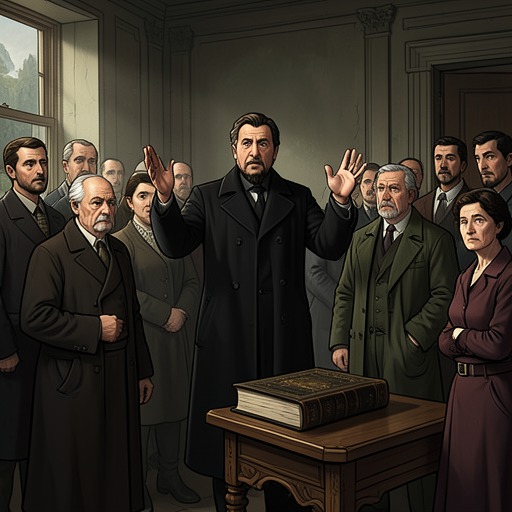
The passage presents its future figure through images of authority, illumination, and speech: “holding the scepter of power in his hand, clothed with light for a covering,” with a mouth that will utter “eternal words” and an inward “fountain of truth.” These details give the promised intervention both political force and divine warrant. The figure is not merely to offer counsel; the revelation assigns him the task of setting the house of God in order. Its language therefore makes correction of religious authority part of the prophecy itself.
The book identifies the passage as Section 85 and gives its date as November 27, 1832. That specificity anchors later interpretations in a revelation attributed to Joseph Smith, rather than in a prediction newly formulated by the fundamentalists who invoke it. The quoted promise is brief, but its central image—one powerful figure arriving to restore order—leaves room for later believers to argue over who that figure is and what restoration requires.
A Fundamentalist Promise of Restoration
The passage gains particular weight in the book’s account of Mormon Fundamentalists, who regard the Church’s abandonment of plural marriage as a grave compromise with the U.S. government. They see themselves as preserving what the Church relinquished, and Section 85 offers them a scriptural expectation that religious authority will be put right again. The book says they cite Section 132 more often, but that Section 85 is likely their second-most-popular scriptural citation.
For many fundamentalists, the “one mighty and strong” is not only a figure of the past or an abstract future hope: they believe he is already among them. They expect him soon to lead the Church back onto the right path and restore what they describe as Joseph Smith’s “most holy and important doctrine.” In this reading, the revelation’s promise of order becomes an argument about the present: the established Church has strayed, and a divinely authorized restorer will correct it. The passage does not, in the evidence presented, name that restorer. Its open identity is precisely what allows different claimants to draw authority from it.
Crossfield’s Claim to the Prophecy
The book connects that interpretive opening to Robert Crossfield’s development as the Prophet Onias. In March 1962, a few months after he began attending prayer meetings with polygamists in Creston, Crossfield said he received a revelation promising that God would raise up “one mighty and strong among you.” The message described the figure as carrying “the scepter of justice” and promised that he would defeat those opposing God’s work. The book explicitly identifies this as a direct reference to Section 85, while noting that the wording shifts from the scriptural “scepter of power” to a “scepter of justice.”
Crossfield did not explicitly claim in public to be the prophesied figure. Yet the book observes that several of his published revelations leave little doubt that privately he considered the possibility that he might be “the one.” The distinction matters: the claim appears not as a simple public announcement but through a sequence of revelations that increasingly locate divine authority in Crossfield himself.
In 1975, that identification became more explicit in a commandment that named him “Onias,” called him the true prophet and rightful leader of the Church, and said he had been placed on earth “to set in order My Church.” The message also made a concrete demand of the United Effort Plan’s leaders: they were supposed to take their marching orders from Crossfield. Section 85’s promise of a restorer thus became, in Onias’s revelations, a claim to jurisdiction over existing religious leaders—not merely a prediction that reform would someday occur.
Scripture, Authority, and Rival Readings
The consequences in Creston show that invoking the prophecy could intensify rather than settle disputes over authority. In 1974, Crossfield received a revelation declaring his version of the One True Church correct and Uncle Roy’s wrong. After the 1975 commandment placed the United Effort Plan’s leaders under his direction, the Creston polygamists’ leader told him he was no longer welcome at their prayer meetings, and Crossfield was expelled from the United Effort Plan. The promise of putting the house of God in order had not produced an agreed order; it had become a basis for rival claims about who possessed the right to give commands.
The passage’s significance in the book lies in this movement from scriptural promise to present-day authority claim. Section 85 supplies a vivid image and an unfinished identity; fundamentalists use it to anticipate restoration, while Crossfield’s revelations make that expectation personally and institutionally specific. The same words can therefore support both a collective hope that the Church will return to a rejected doctrine and an individual assertion that the prophet who can accomplish that return is already among the believers. The book presents the prophecy not as a resolution to religious division, but as language through which division can be interpreted, authorized, and deepened.